Choosing the right sports court surface affects student safety, athletic performance, maintenance costs, accessibility, and the long-term value of a school or university facility. A reliable Sports Court Surface Manufacturer can help a purchasing team compare surface systems, installation requirements, warranties, and lifecycle costs instead of choosing only by the lowest initial price.
This guide explains how to select sports court surfaces step by step. It is designed for school administrators, university facility managers, athletic directors, architects, contractors, procurement officers, coaches, and finance teams.
Start with the needs of your school or university
Identify the people who will use the court
The correct surface depends on who will use the court, how often it will be used, and what activities will take place on it. A primary school court may need extra impact protection and simple maintenance, while a university competition court may require a certified performance system.
- Students using the court during physical education classes.
- School or university teams training and competing.
- Community groups using the facility after school hours.
- Coaches who need predictable ball response and player traction.
- Facility managers responsible for cleaning, repairs, and scheduling.
- Procurement teams comparing price, warranty, and supplier reliability.
- Architects and contractors responsible for specifications and installation.
- Finance departments reviewing total ownership costs.
Define the main sports and usage pattern
List every sport that will use the court before comparing products. A surface designed primarily for basketball may not be ideal for tennis, volleyball, futsal, badminton, or multipurpose use.
- Basketball requires consistent traction, controlled sliding, and reliable ball rebound.
- Volleyball requires good shock absorption and a surface that reduces excessive leg fatigue.
- Tennis requires predictable ball bounce, comfortable movement, and suitable pace.
- Futsal requires durable wear resistance, stable traction, and easy cleaning.
- Badminton requires low glare, stable foot movement, and accurate court markings.
- Multipurpose courts require a balanced performance specification rather than optimization for only one sport.
Record the practical purchasing pain points
Purchasing groups often face the same problems: unclear technical specifications, incomplete quotations, uncertain installation quality, unexpected subfloor repairs, poor drainage, limited maintenance staff, and pressure to reduce the initial budget. Write these concerns into the project brief so suppliers must respond to them directly.
- Need for a safe surface for different ages and skill levels.
- Need for a surface that can withstand frequent classes and competitions.
- Need for predictable project costs with few variations.
- Need for installation during a short school holiday period.
- Need for low odor and low disruption during construction.
- Need for clear cleaning and repair instructions.
- Need for a documented warranty and responsive after-sales support.
- Need to meet local safety, accessibility, and sports federation requirements.
Follow a site assessment before choosing a surface
Required tools for the assessment
A basic site assessment prevents the purchasing team from selecting a surface that cannot be installed properly on the existing floor or outdoor base.
- Laser distance meter or measuring tape.
- Digital camera or mobile phone for photographs.
- Moisture meter suitable for concrete or wood.
- Straightedge at least 2 meters long.
- Spirit level or digital level.
- Surface temperature and humidity meter.
- Concrete hardness or pull-off testing equipment when required.
- Drainage inspection tools for outdoor courts.
- Site plan, existing drawings, and maintenance records.
- Data sheet and warranty documents from each shortlisted supplier.
First step: Measure the court and surrounding area
Measure the playing area, run-off zones, entrance routes, storage areas, wall clearances, and drainage points. Do not measure only the painted lines. The total installation area may include edge zones, ramps, transitions, skirting, shock pads, and protective coatings.
- Measure the length and width of the playing area.
- Measure the total floor area that will receive the surface system.
- Record columns, drains, doorways, expansion joints, and floor penetrations.
- Check whether equipment can enter the building or reach the outdoor court.
- Prepare a scaled drawing for supplier quotations.
Second step: Inspect the subfloor condition
The subfloor is one of the most important factors in surface performance. A high-quality top layer cannot correct serious cracking, moisture, settlement, or unevenness below it.
- Check concrete for cracks, hollow areas, dusting, laitance, and oil contamination.
- Check wood for movement, loose boards, rot, warping, and poor ventilation.
- Use a straightedge to locate high and low areas.
- Test moisture before applying adhesives, coatings, or resilient layers.
- Record expansion joints and confirm how the proposed system will accommodate movement.
- Ask a qualified contractor to investigate structural movement or settlement.
Third step: Assess the indoor or outdoor environment
Temperature, humidity, sunlight, rain, snow, and drainage influence the correct surface selection. Indoor and outdoor courts should not be evaluated using the same assumptions.
- Indoor courts need good humidity control, low odor products, and suitable ventilation during installation.
- Outdoor courts need resistance to ultraviolet exposure, rain, temperature changes, and standing water.
- Courts in humid regions need moisture management and mold-resistant maintenance procedures.
- Courts in cold regions need a system that can tolerate freeze and thaw movement.
- Courts in hot regions need color stability and resistance to thermal expansion.
- Courts near trees may require additional cleaning because of leaves, sap, and roots.
Compare the main sports court surface systems
Indoor hardwood surfaces
Hardwood is commonly selected for high-level indoor basketball and volleyball facilities because it provides a consistent playing response and a traditional competition appearance. It requires accurate subfloor preparation, humidity control, regular refinishing, and protection from moisture.
- Best suited to indoor basketball, volleyball, and premium athletic facilities.
- Advantages include strong appearance, consistent ball response, and professional presentation.
- Limitations include higher installation cost, moisture sensitivity, and regular maintenance requirements.
- Important questions include wood species, board structure, subfloor system, shock absorption, finish, and refinishing schedule.
Prefabricated rubber surfaces
Rubber systems can provide impact absorption, durability, and comfortable movement. They are often considered for indoor multipurpose areas, school gyms, fitness spaces, and facilities where reduced maintenance is important.
- Best suited to multipurpose indoor facilities and high-use school environments.
- Advantages include resilience, reduced joint impact, and good resistance to daily wear.
- Limitations may include higher material cost, seam visibility, and the need for precise adhesive installation.
- Important questions include thickness, shock absorption, indentation resistance, seam treatment, and repair method.
Polyurethane sports flooring
Polyurethane systems are installed as seamless or layered coatings over a prepared base. They can be specified with different levels of cushioning and are suitable for many indoor multipurpose courts.
- Best suited to indoor schools, universities, training halls, and multipurpose courts.
- Advantages include seamless appearance, customizable cushioning, and easy line marking.
- Limitations include sensitivity to installation conditions and the need for careful curing time.
- Important questions include system thickness, elastic layer design, surface texture, odor control, and cure time.
Acrylic outdoor surfaces
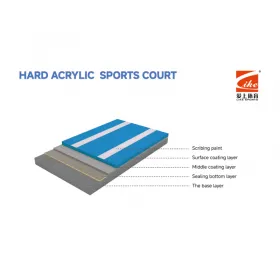
Acrylic coatings are widely used for outdoor basketball, tennis, volleyball, and multipurpose courts. They can be applied over asphalt or concrete and are available in different texture and cushioning options.
- Best suited to outdoor courts exposed to sunlight and changing weather.
- Advantages include color flexibility, relatively simple maintenance, and strong outdoor usability.
- Limitations include the need for a stable base, possible fading, and the need to repair cracks before coating.
- Important questions include ultraviolet resistance, crack treatment, coating thickness, texture, drainage, and recoating intervals.
PVC and vinyl sports flooring
PVC and vinyl systems are used in indoor sports halls and multipurpose spaces where resilient performance, easy cleaning, and flexible design are important. The surface must be installed on a flat, dry, and clean base.
- Best suited to indoor multipurpose courts, school halls, and facilities requiring frequent cleaning.
- Advantages include a wide range of colors, easy maintenance, and practical installation options.
- Limitations include possible damage from heavy equipment, poor subfloor preparation, or inappropriate cleaning chemicals.
- Important questions include wear layer thickness, slip resistance, seam welding, indentation resistance, and replacement options.
Set performance and safety requirements before requesting prices
Specify shock absorption and force reduction
A school surface should support safe movement without feeling unstable. Ask suppliers to provide test data for force reduction, vertical deformation, area indentation, and rolling load performance when these measurements apply to the selected system.
- Choose a performance level suitable for the main sports and age groups.
- Consider additional cushioning for facilities used by younger students or people with different mobility needs.
- Compare test results from the complete installed system, not only the top coating.
- Ask how performance may change after years of use.
Specify traction and controlled sliding
A court should provide enough grip for acceleration and stopping while allowing controlled movement. Excessive slipperiness increases fall risk, while excessive grip can increase stress on joints.
- Request slip resistance data for dry and wet conditions where relevant.
- Confirm that the texture is appropriate for the sports shoes normally used.
- Ask whether dust, cleaning residue, or wear can change traction.
- Require a sample area or reference facility when possible.
Specify ball response, glare, and visual quality
Sports teams and physical education teachers need a predictable surface. Color, gloss, texture, and uniformity can affect visibility and playability.
- Check ball rebound consistency across the complete playing area.
- Choose colors that provide clear contrast with the ball and line markings.
- Use low-glare finishes in areas with strong artificial or natural lighting.
- Confirm that line markings will remain sharp after cleaning and normal wear.
Check accessibility and user safety
The court should form part of an accessible facility rather than creating new barriers. Transitions, thresholds, ramps, edges, and entrances require the same attention as the playing surface.
- Provide smooth transitions between the court and surrounding floor.
- Avoid raised edges and unexpected changes in level.
- Confirm that the surface is suitable for users with mobility aids when required.
- Coordinate surface selection with lighting, wall protection, equipment anchoring, and emergency access.
Build a complete budget instead of comparing material prices
Separate initial costs from lifecycle costs
The lowest material quotation may not be the lowest-cost solution over the life of the court. Compare the complete cost of preparation, installation, maintenance, repairs, and future replacement.
- Subfloor testing and preparation.
- Moisture control and crack repair.
- Surface materials and accessories.
- Adhesives, primers, shock pads, and protective layers.
- Installation labor and equipment.
- Line marking and logos.
- Transport, taxes, and site storage.
- Waste removal and final cleaning.
- Routine cleaning products and equipment.
- Periodic recoating, refinishing, or replacement.
Ask for a five-year or ten-year cost comparison
Request a cost model from each shortlisted supplier. It should show the initial investment, expected maintenance intervals, repair costs, downtime, and expected service life. This helps finance teams compare systems fairly.
| Cost category |
Questions to ask |
| Initial installation |
Does the quotation include subfloor preparation, materials, labor, equipment, and line marking? |
| Maintenance |
How often must the surface be cleaned, recoated, refinished, or inspected? |
| Repairs |
Can damaged areas be repaired locally, or must the entire area be replaced? |
| Downtime |
How long will the court be unavailable during installation and future maintenance? |
| Warranty |
What is covered, what is excluded, and who pays for labor or transport? |
Plan the installation in clear stages
First step: Prepare the project documents
Before work begins, confirm the approved specification, drawings, colors, court layout, schedule, responsibilities, and acceptance criteria. Written documents reduce disagreements between the school, contractor, and supplier.
- Approved product data sheets.
- Subfloor preparation requirements.
- Moisture and temperature limits.
- Installation drawings and line marking plan.
- Color samples and logo artwork.
- Delivery schedule and storage instructions.
- Inspection and testing plan.
- Warranty and maintenance documents.
Second step: Prepare and test the base
The installer should clean, repair, level, and prime the base according to the system requirements. Moisture and environmental conditions should be recorded before each major installation stage.
- Remove dust, oil, old coatings, loose materials, and contaminants.
- Repair cracks, joints, holes, and damaged areas.
- Grind or level uneven sections.
- Confirm moisture content and environmental conditions.
- Apply primer or vapor control treatment when specified.
- Obtain written approval of the prepared base before installing the surface.
Third step: Install the surface system
Installers should follow the complete system sequence provided by the manufacturer. Skipping layers or changing materials can affect adhesion, cushioning, durability, and warranty coverage.
- Install the required moisture barrier, underlayment, or shock pad.
- Install the main surface layer according to the specified thickness.
- Allow each layer to cure for the required time.
- Inspect seams, edges, joints, and transitions.
- Apply the wear layer or protective finish.
- Mark court lines after the surface has reached the required cure condition.
- Remove protective coverings and complete final cleaning.
Fourth step: Inspect and test before opening the court
Do not open the facility immediately after installation simply because the surface looks complete. The installation team should verify appearance, levelness, adhesion, line accuracy, traction, and curing.
- Check the surface for bubbles, wrinkles, pinholes, color variation, and visible contamination.
- Check that court lines are straight, accurate, and correctly positioned.
- Check transitions, edges, drains, and equipment anchor points.
- Confirm that the surface is fully cured before heavy use.
- Record photographs and test results for the project file.
- Obtain cleaning, maintenance, and warranty documents before final payment.
Evaluate Sports Court Surface Manufacturers carefully
Request a complete technical quotation
A professional quotation should describe the complete surface system rather than listing only a product name. Ask each supplier to provide comparable information in the same format.
- System composition and layer sequence.
- Total installed thickness and tolerance.
- Shock absorption and deformation data.
- Traction and slip resistance information.
- Durability and wear resistance data.
- Indoor or outdoor suitability.
- Subfloor requirements and moisture limits.
- Installation time and curing time.
- Cleaning and maintenance instructions.
- Warranty terms and exclusions.
- References for similar schools or universities.
Check installation capability and project experience
Even a good product can fail when installed by an inexperienced team. Ask who will perform the work, where the team is based, and how quality will be controlled.
- Request photos and references from completed education projects.
- Confirm whether the supplier uses trained or approved installers.
- Ask how subfloor problems are documented and priced.
- Confirm who supervises the installation.
- Ask how defects and warranty claims are handled.
- Request a proposed inspection schedule.
- Confirm the availability of spare materials and repair support.
Compare samples and reference courts
Written specifications are important, but users should also experience the surface. Arrange a sample review with the athletic director, coaches, facility manager, and procurement team.
- Review the color, gloss, texture, and appearance.
- Walk and change direction on the sample surface.
- Test ball response where practical.
- Ask users whether the surface feels too hard, too soft, too slippery, or too sticky.
- Visit a reference court that has been in service for several years.
- Ask the facility manager about cleaning, repairs, downtime, and supplier support.
Avoid common sports court surface purchasing mistakes
Do not choose only by the lowest initial price
A low quotation may exclude base preparation, moisture treatment, line marking, transport, or future maintenance. Compare complete installed systems and lifecycle costs before making a decision.
Do not ignore the subfloor
Cracks, moisture, movement, and unevenness can cause bubbling, peeling, seam failure, or premature wear. Make subfloor testing a required part of the tender process.
Do not use one surface for every sport without checking suitability
A surface that performs well for outdoor tennis may not provide the required cushioning for indoor volleyball. Confirm the performance requirements for every major activity planned for the court.
Do not rely on a product name without technical data
Different suppliers may use similar marketing terms for systems with very different performance levels. Request measurable data for thickness, force reduction, traction, wear, moisture limits, and service life.
Do not schedule installation without an environmental plan
Coatings and adhesives may fail when applied in unsuitable temperature or humidity conditions. Confirm ventilation, heating, dehumidification, curing time, and protection from traffic.
Do not forget maintenance training
Using the wrong cleaning chemicals, dragging heavy equipment, or allowing standing water can shorten the life of a sports surface. Require staff training and a written maintenance schedule during handover.
Do not accept vague warranty terms
A warranty should state the coverage period, covered defects, exclusions, maintenance obligations, inspection requirements, and claim procedure. Ask for clarification before signing the contract.
Use this final selection checklist
Confirm the facility requirements
- Have all sports and user groups been identified?
- Has the expected daily and weekly usage been estimated?
- Have indoor or outdoor environmental conditions been reviewed?
- Have accessibility, lighting, drainage, and equipment requirements been included?
Confirm the technical requirements
- Has the subfloor been tested for levelness, moisture, cracks, and movement?
- Are shock absorption and traction requirements documented?
- Are ball response, glare, color, and line marking requirements documented?
- Are installation conditions and curing times included?
- Are testing and acceptance criteria written into the contract?
Confirm the commercial requirements
- Does the quotation include all preparation and installation work?
- Are maintenance and repair costs included in a lifecycle comparison?
- Are delivery dates compatible with the school calendar?
- Are installer qualifications and project references available?
- Are warranty terms, spare materials, and after-sales support clear?
Make the final decision with a weighted scorecard
Score each supplier against the same criteria
A scorecard helps the purchasing group make a transparent decision when several surfaces meet the basic requirements. Adjust the weighting to match the project priorities.
| Evaluation factor |
Suggested weight |
| Safety and sports performance |
25 percent |
| Subfloor and installation suitability |
15 percent |
| Durability and expected service life |
15 percent |
| Lifecycle maintenance cost |
15 percent |
| Initial project cost |
10 percent |
| Installation schedule and disruption |
10 percent |
| Warranty and after-sales support |
10 percent |
Approve the system, not just the surface color
The final approval should cover the complete system, including the base preparation method, cushioning layer, surface layer, finish, line markings, accessories, installation process, testing, and maintenance plan. This prevents the project from being changed to a cheaper but unapproved material after the contract is signed.
For schools and universities, the best choice is the surface that delivers safe performance, dependable durability, manageable maintenance, and predictable total cost. Working with an experienced Sports Court Surface Manufacturer such as LIKE SPORTS can help the purchasing group obtain suitable specifications, installation guidance, and long-term support for the facility.
Start with a documented site assessment, compare complete systems, verify technical data, inspect installation quality, and train the maintenance team before opening the court. These steps give LIKE SPORTS customers and other education buyers a clearer path to a safer and more durable sports facility. Learn more at LIKE SPORTS, your Sports Court Surface Manufacturer for school and university projects.