Choosing between PU vs acrylic sports court surface depends on the venue, climate, playing level, and maintenance budget. Facility owners comparing the best sports court surface for basketball or an outdoor tennis court surface comparison should examine polyurethane flooring, acrylic court coating, and shock absorption rather than relying on appearance alone. The key technical factors are polyurethane chemistry, aliphatic UV stability, and the coefficient of friction under dry and wet conditions.
A school may need a durable, economical surface that withstands several classes each day, while a professional training center may prioritize joint protection, consistent ball response, and controlled slide characteristics. The wrong specification can lead to premature cracking, uncomfortable impact, poor drainage, or repeated closure for repairs. This guide compares PU and acrylic systems by construction, measurable performance, venue suitability, cost, maintenance, and user experience.
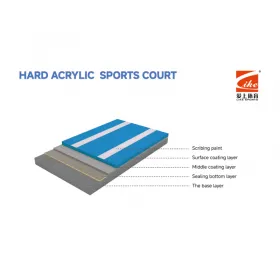
Before comparing brands or prices, it helps to understand what is actually under the players’ feet.
A typical PU court is a multilayer elastic system. The installer first prepares the concrete or asphalt substrate, applies a primer, installs an elastic polyurethane base layer, adds one or more self-leveling or cushion layers, and finishes with colored PU coats and line marking. Depending on the specification, the total system thickness is commonly about 3–12 mm.
Elastic PU systems are designed to deform slightly under load and recover afterward. Testing may include EN 14808 shock absorption, EN 14809 vertical deformation, EN 13036-4 slip resistance, and EN 14904 requirements for indoor sports floors. A higher shock-absorption value generally reduces transmitted impact, although excessive elasticity can alter ball rebound and player movement.
There are two important chemistry choices. Aromatic polyurethane can discolor under long-term ultraviolet exposure, while aliphatic polyurethane offers better color retention and UV stability. For outdoor projects, the manufacturer should state whether the topcoat is aliphatic and provide a weathering or color-retention specification instead of simply calling the system “UV resistant.”
Acrylic courts are usually built over asphalt or concrete with a resurfacer, crack filler, acrylic color coats, and textured or silica-filled top layers. The coating system is often approximately 1.5–4 mm thick, although cushioning acrylic systems can be thicker when rubber or elastic layers are added beneath the color coats.
Traditional acrylic is comparatively firm. It provides a predictable playing response, clear line definition, and low initial cost, but it transfers more impact to the athlete than a properly designed cushioned PU system. Acrylic texture also affects traction: a coarser surface can improve grip but may increase abrasion on shoes and sliding contact, while a smoother surface can become slippery if water, algae, dust, or coating wear is not controlled.
| Evaluation factor | PU sports flooring | Acrylic court coating | Practical meaning |
|---|---|---|---|
| Typical thickness | Approximately 3–12 mm | Approximately 1.5–4 mm for non-cushioned systems | Thicker PU systems can provide greater impact attenuation, but substrate preparation remains essential. |
| Shock absorption | Commonly specified as an elastic performance system; project values may be approximately 15–35%, depending on design | Traditional systems commonly provide limited inherent shock absorption; cushioned acrylic improves this | PU is generally more suitable where repetitive jumping and running create high joint loads. |
| Ball response | Consistent when hardness and thickness are controlled; softer systems can slightly reduce rebound speed | Fast and predictable on a firm, even substrate | Tennis facilities should match surface pace and friction to the playing standard. |
| UV and color retention | Strong outdoor performance when an aliphatic UV-stable topcoat is used | Generally strong outdoor color performance, subject to pigment and coating quality | Ask for accelerated weathering data rather than relying on color samples alone. |
| Crack-bridging capability | Elastic systems can bridge some static hairline movement, but they cannot correct structural cracks | Rigid coatings are more likely to mirror significant substrate movement | Both systems require crack repair and moisture control before installation. |
| Surface repair | Localized color and texture matching can be more demanding | Patch repairs are usually simpler when the same batch and texture are available | Acrylic is often easier to maintain on public courts with frequent minor damage. |
| Indicative installed cost | Approximately US$6–16 per square foot, depending on layers, substrate work, location, and certification | Approximately US$3–9 per square foot for common resurfacing systems | These are planning ranges, not quotations; drainage, demolition, and foundation repairs can change the total substantially. |
| Expected service period | Often about 8–15 years with suitable maintenance and climate control | Often about 4–10 years before major resurfacing, depending on traffic and weather | Actual life depends more on substrate movement, water management, and maintenance than on coating type alone. |
The table shows why a low purchase price does not always equal a low lifecycle cost. If a public court requires resurfacing every five years, a cheaper acrylic installation may cost more over a 15-year period than a correctly specified PU system with a higher initial price.
For an indoor basketball court, PU is often the stronger choice when the court is used daily by children, teenagers, and adult leagues. Repeated jumping, abrupt stops, and lateral movement place considerable stress on the ankles, knees, and lower back. A cushioned PU system can be specified to provide measurable shock absorption while maintaining a controlled coefficient of friction.
Acrylic remains practical for outdoor community basketball courts where the budget is limited and the priority is a firm, recognizable playing surface. It is especially suitable when the concrete or asphalt base is stable, drainage is good, and the court is not marketed as a high-performance training facility.
One school facility manager described the decision this way: the school initially considered a low-cost acrylic resurfacing because the court had to reopen before the autumn term. After comparing maintenance interruptions and student use, the team selected a cushioned PU system for the indoor court and reserved acrylic for the outdoor practice court. The manager’s main observation was not that PU “felt softer,” but that players reported fewer complaints after long training sessions. This is a user account, not a controlled medical study, but it reflects the practical distinction between a firm coating and an elastic floor.
Tennis requires more than comfort. The surface influences ball speed, bounce height, player recovery, and sliding behavior. Acrylic is widely used for outdoor hard courts because it delivers a firm, consistent bounce and can be textured to adjust pace. A standard acrylic system is often a logical choice for clubs, schools, and municipal courts.
PU can work well for indoor tennis and premium multi-sport venues, particularly when players need a more forgiving surface during long sessions. However, a soft PU system may not be ideal for every tennis program. The specification should include coefficient of friction, ball rebound, vertical deformation, and surface pace targets. A supplier that only provides a color card and a generic thickness figure has not supplied enough information for a serious tennis project.
Indoor badminton places high demands on footwork, braking, and repeated lunges. A cushioned PU system can reduce the harsh sensation associated with a rigid substrate, especially when players train for several hours. Nevertheless, the surface must not be so soft that it delays push-off or changes the athlete’s balance.
For a multi-sport hall hosting badminton, volleyball, basketball, and school activities, PU usually offers greater design flexibility. The owner can select different wear layers and line-marking systems while maintaining a continuous, seamless surface. Acrylic may be acceptable for light-use indoor areas, but it is less forgiving when the underlying slab is uneven or when the facility expects premium athletic performance.
Acrylic is often the practical option for outdoor pickleball and volleyball courts because it handles frequent recreational use at a controlled installation cost. Its textured finish can provide reliable traction, and damaged areas can usually be recoated without replacing a thick elastic system.
PU becomes more attractive when the outdoor venue is positioned as a premium sports destination, when users include competitive athletes, or when the owner wants enhanced impact attenuation. In this setting, the topcoat must be selected for ultraviolet exposure, rain cycles, and temperature movement. PU should not be treated as automatically weatherproof; poor drainage and trapped moisture can damage any seamless court system.
When a contractor presents a price per square meter or square foot, ask what is included. A meaningful quote should separate substrate repair, moisture testing, crack treatment, primer, elastic layers, color coats, line marking, curing time, and post-installation inspection.
For planning purposes, a basic outdoor acrylic resurfacing project may fall near US$3–9 per square foot. A multi-layer PU system may fall near US$6–16 per square foot. A severely cracked slab, poor drainage, demolition requirement, or indoor moisture barrier can add substantially to either figure.
Consider a 10,000-square-foot facility. A US$5 per square foot acrylic project would have an initial coating cost of about US$50,000, excluding major substrate work. A US$10 per square foot PU system would cost about US$100,000. If the acrylic surface requires major resurfacing in year five and again in year ten, while the PU system remains serviceable through year twelve with scheduled recoating, the lifecycle difference may be smaller than the initial quotation suggests.
Maintenance also affects the calculation. Both systems need regular sweeping, prompt removal of leaves and standing water, controlled cleaning chemicals, and inspection of cracks and joints. Acrylic often permits simpler spot repairs. PU may reduce replacement frequency but requires more specialized repair matching, especially when the surface includes multiple elastic layers or a decorative broadcast texture.
Feedback from facility operators tends to follow a consistent pattern. Acrylic users often praise the firm response, strong visual contrast, and manageable resurfacing budget. Their complaints usually concern hard impact, surface fading, cracking over moving substrates, and slipperiness caused by dirt or algae.
PU users commonly value the quieter footfall, softer impact response, seamless finish, and premium appearance. Their concerns usually involve higher upfront cost, longer installation scheduling, more demanding substrate preparation, and the need to select a UV-stable topcoat for exterior applications.
A sports center manager who had operated both systems explained that the acrylic outdoor courts were easier to patch after occasional vandalism and heavy public use. In the indoor hall, however, the PU floor was preferred by coaches because the surface remained comfortable during double-session training days. The manager’s conclusion was balanced: acrylic was the better maintenance-value choice outdoors, while PU produced the better indoor training environment.
These experiences should not be interpreted as universal test results. User feedback is most useful when it is connected to measurable conditions such as hours of use per week, indoor or outdoor exposure, cleaning frequency, substrate type, and installation age.
LIKE SPORTS is worth including in the comparison because a manufacturer’s value is not limited to the coating itself. A suitable supplier should help match layer design, texture, color, line marking, installation method, and maintenance plan to the venue rather than selling one universal system.
PU is generally better for indoor, high-use, multi-sport, and athlete-focused venues where shock absorption, seamless construction, and long training comfort justify a higher initial investment. It is not the best choice for every project: poor moisture control, weak substrate preparation, or an uncontrolled outdoor environment can undermine its advantages.
Acrylic is generally better for outdoor community courts, school practice areas, tennis, pickleball, and projects where initial cost, firm ball response, easy recoating, and simple spot maintenance are central requirements. It is not automatically unsuitable for athletes, but a standard hard acrylic system offers less impact attenuation than a properly engineered cushioned PU floor.
In the end, the best PU vs acrylic sports court surface decision comes from matching the material to actual use: court type, indoor or outdoor exposure, weekly playing hours, climate, substrate movement, maintenance capacity, and lifecycle budget. Request two itemized proposals, compare test data rather than adjectives, and evaluate a cured sample under real footwear before approving the installation. For a venue-specific recommendation, ask LIKE SPORTS or another qualified Sports Court Surface Manufacturer to prepare a layer-by-layer specification, maintenance schedule, and total-cost estimate based on your court dimensions and operating conditions.
Previous: None
Please leave message
Please leave message 




+86 181 2230 3341


