Self-textured and spray granular running tracks can both use a full polyurethane base, but their surface structures and performance characteristics are different. The correct choice depends on the venue type, expected usage, athlete requirements, installation conditions and maintenance plan.
For schools, stadiums, universities and community sports facilities, buyers should not select a running track simply because one system has a smoother appearance or a lower initial quotation. The surface texture, deformation, slip resistance, construction process and long-term wear behavior should all be considered.
This guide compares the two systems and explains where each option is more suitable.
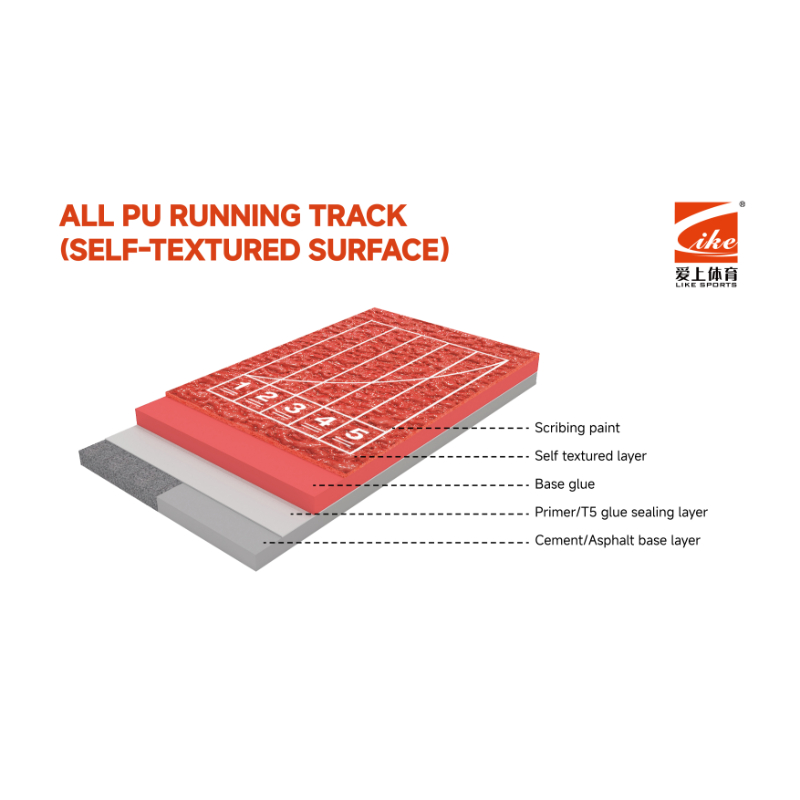
A self-textured full PU running track uses polyurethane throughout its main elastic structure. Its upper surface is formed with a textured polyurethane coating rather than a layer of sprayed rubber granules.
LIKE SPORTS describes its system as using a pearl-grain self-textured spray adhesive and a waxing process that does not rely on a solvent-based waxing method. The polyurethane base is designed to provide wear resistance, physical strength and resistance to aging.
The self-textured system is commonly selected when a project requires:
A uniform surface appearance
Consistent traction
High elongation
Controlled vertical deformation
Easy surface cleaning
Stable performance under frequent use
A professional-looking finish
The manufacturer lists stadiums, schools, training centers and community sports facilities among its intended applications.
A spray granular full PU running track also uses a polyurethane elastic base, but the upper surface is created by spraying a mixture of polyurethane binder and rubber granules.
The granular surface gives the track a more traditional textured appearance. It can provide traction while helping the system accommodate weather exposure and repeated foot traffic.
LIKE SPORTS states that its spray granular system uses solvent-free materials, a one-step base layer and a granular spray adhesive formulated to encapsulate the surface granules and reduce granule loss.
Typical applications include:
School and university sports fields
Community fitness parks
Outdoor jogging tracks
Stadiums
Renovation of existing tracks
High-traffic public sports facilities
| Comparison Factor | Self-Textured Full PU | Spray Granular Full PU |
|---|---|---|
| Surface structure | Textured polyurethane finish | PU binder with sprayed rubber granules |
| Surface appearance | Uniform and relatively refined | More visibly granular |
| Listed tensile strength | 1.26 MPa | 1.26 MPa |
| Listed elongation at break | 450% | 171% |
| Listed shock absorption | 35%–50% | 35%–50% |
| Listed vertical deformation | 1.3 mm | 2.4 mm |
| Listed slip-resistance value | 86 BPN at 20°C | 78 BPN at 20°C |
| Flame-retardant rating | Level I | Level I |
| Main surface process | Self-textured coating sprayed twice | Granular spray layer |
| Common project positioning | Performance-focused schools, stadiums and training venues | Schools, communities, public tracks and renovation projects |
The values above are based on the manufacturer’s current published data. Final performance should be confirmed through the technical datasheet, test report and proposed installed thickness for the specific project.
The self-textured system has a published sliding-resistance value of 86 BPN at 20°C, compared with 78 BPN for the spray granular system. This suggests that the tested self-textured product provides a higher measured level of surface resistance under the stated test conditions.
However, a higher value should not be considered independently. Excessive surface roughness can affect athlete comfort and skin-abrasion risk, while insufficient resistance may increase slipping in wet conditions.
The correct surface should provide:
Reliable traction during acceleration
Stability when turning
Predictable contact in wet conditions
Comfortable use during long training sessions
Consistent performance across the complete track
A project specification should therefore identify the required test standard and acceptable performance range rather than simply asking for the highest possible slip-resistance value.
Both systems list shock absorption between 35% and 50%, but their published elongation and vertical-deformation values differ.
The self-textured system lists:
Elongation at break: 450%
Vertical deformation: 1.3 mm
The spray granular system lists:
Elongation at break: 171%
Vertical deformation: 2.4 mm
These figures indicate that the two surfaces respond differently under load, even though their shock-absorption ranges are similar.
Vertical deformation affects how soft or firm the track feels under an athlete’s foot. A surface with greater deformation may feel more cushioned, while a lower-deformation surface may provide a firmer response.
The ideal value depends on:
Athlete level
Sprinting or general fitness use
Track thickness
Base hardness
Local temperature
Required competition standard
Daily user volume
Buyers should request data for the complete installed system, not only an individual polyurethane material.
A self-textured polyurethane surface does not depend on exposed loose granules for its final texture. This can make cleaning and surface inspection more straightforward.
The manufacturer states that the self-textured layer uses a high-molecular-chain polyether compound to improve adhesion and internal strength. The base material is also described as wear-resistant and resistant to long-term aging.
The spray granular system depends partly on the adhesion between the rubber granules and spray binder. Good encapsulation is important because insufficient binder or poor installation can result in granule shedding.
LIKE SPORTS describes its spray adhesive as having strong granule encapsulation and says the surface uses pigments intended to provide lasting color and wear resistance.
For either system, durability is influenced by:
Polyurethane quality
Mixing accuracy
Layer thickness
Substrate stability
Installation temperature
Curing time
UV exposure
Drainage
Maintenance practices
A technically strong material may still fail early when installed over a cracked, damp or poorly prepared base.
The self-textured system uses the following published process:
Base-layer inspection
Base-layer treatment
Base-layer sealing
Base-glue construction
Grinding and repair
Strengthening-layer construction
Additional grinding and repair
Two applications of self-textured surface adhesive
Line marking
Site acceptance
The spray granular system follows a similar base preparation and elastic-layer process, but its final wearing course is a granular spray layer rather than two self-textured coating applications.
This difference affects installation equipment, material consumption, surface consistency and repair methods.
Before selecting either system, confirm:
Required substrate strength
Concrete or asphalt moisture level
Surface flatness
Primer compatibility
Number and thickness of layers
Curing time between layers
Weather limitations during installation
Acceptance tests after completion
Both product pages describe solvent-free or environmentally conscious construction and state compliance with the Chinese GB 36246-2018 standard. Published chemical test information includes results for volatile organic compounds, formaldehyde, phthalates, benzene, soluble heavy metals and other controlled substances.
For an international project, buyers should still request:
The complete chemical test report
Tested product name
Sample date
Testing laboratory
Applicable standard
Test method
Installed system specification
Destination-market requirements
Compliance with one national standard does not automatically demonstrate compliance with every country’s regulations or tender requirements.
A school running track must handle physical education classes, sports training, recreational use and frequent daily traffic.
A self-textured full PU track may be preferred when the school wants:
A more uniform appearance
Higher published slip resistance
A firmer tested deformation value
Reduced dependence on exposed surface granules
A performance-focused track for structured training
A spray granular full PU track may be more suitable when the project requires:
A traditional granular track texture
A more cushioned tested deformation value
Broad use across sports and recreation
Renovation of an existing asphalt or concrete track
A balance between performance and project cost
The final choice should also consider student age, daily traffic, climate and maintenance resources.
For professional or competition-oriented venues, the decision should be based on the required certification, installed thickness and complete system test results.
A self-textured system may offer advantages where consistent surface friction and a uniform finish are priorities. The manufacturer promotes its full PU self-textured track for stadiums and professional sports facilities and lists a 13 mm athletic track option.
A spray granular system can also be used for stadium and training applications, but buyers should evaluate whether the proposed configuration meets the project’s performance and certification requirements.
Do not rely on a general company certificate. Request documentation for the exact:
Product system
Layer structure
Thickness
Installation method
Surface color
Intended competition category
Both systems require regular inspection and cleaning.
For a self-textured surface, maintenance may focus on:
Local coating wear
Cracks
Loss of texture
Color fading
Line-marking wear
Surface contamination
For a spray granular surface, maintenance should also check:
Loose granules
Granule loss
Uneven spray texture
Local binder failure
Worn high-traffic lanes
Small areas should be repaired before water reaches the elastic layer or substrate. The compatibility of new repair material with the original track should be confirmed before resurfacing.
Choose a self-textured full PU running track when the project prioritizes a uniform surface, high published slip resistance, controlled deformation and a professional appearance.
Choose a spray granular full PU running track when the venue prefers a traditional textured surface, greater tested vertical deformation, broad recreational use or a practical renovation solution.
Before ordering, provide the supplier with:
Total track area
Number of lanes
Intended usage
Required thickness
Required certification
Existing base condition
Local temperature and rainfall
Project completion date
Installation location
Maintenance expectations
The most suitable track is not determined only by surface type. It is the system that matches the venue’s performance requirements, substrate conditions, climate, installation quality and long-term operating budget.
Previous: None
Please leave message
Please leave message 




+86 181 2230 3341


