What Causes Sports Court Surface Peeling and Delamination? Sports court surface peeling is the lifting or flaking of a coating from the court, while delamination is the loss of adhesion between coating layers or between the coating and the substrate. For facility owners, understanding these failures helps prevent player injuries, protect court performance, reduce closure time, and avoid costly resurfacing. A qualified Sports Court Surface Manufacturer such as LIKE SPORTS can reduce these risks through correct material selection, substrate preparation, controlled installation, and documented quality inspection.
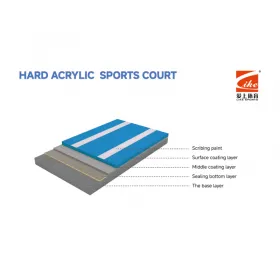
A sports court is not simply painted concrete or asphalt. It is a multi-layer athletic flooring system that may include a concrete or asphalt substrate, primer, repair compound, acrylic resurfacer, cushion layer, color coating, and line-marking paint. Each layer must bond correctly and remain compatible with the layers above and below it.
Proper adhesion supports several practical functions:
For these reasons, the question “What Causes Sports Court Surface Peeling and Delamination?” is also a maintenance, safety, and lifecycle-cost question.
Excess moisture is one of the most common causes of coating failure. Water can remain inside concrete, migrate upward through capillaries, or enter through cracks and joints. When the temperature rises, trapped moisture may become vapor and create pressure beneath the coating. This pressure can produce blistering, bubbling, peeling, and widespread delamination.
Moisture problems may be caused by:
A professional contractor should measure substrate moisture and relative humidity before installation. The acceptable limit depends on the coating system and manufacturer’s technical data sheet. A surface that appears dry may still contain enough internal moisture to cause adhesive failure.
Even a high-quality acrylic or polyurethane coating can fail if the substrate is dirty, weak, or contaminated. Dust, curing compounds, grease, oil, old flaking paint, laitance, and loose particles prevent mechanical and chemical adhesion.
Typical preparation methods include:
Surface profile is important because the coating needs sufficient microscopic texture to anchor to the substrate. However, excessive grinding can expose weak aggregate or create an uneven profile. Preparation should therefore be specified according to the substrate condition and coating system.
Delamination can occur between two otherwise sound layers. Common examples include a color coat separating from a resurfacer or line-marking paint peeling from the acrylic color coat. This often results from incompatible materials, insufficient drying time, excessive contamination, or recoating outside the recommended window.
Important variables include:
Applying a new coating over an unknown old system is a common error. A test patch and adhesion assessment should be completed before full installation.
Coatings must be mixed and applied according to the technical data sheet. Too much water or solvent can weaken the film, reduce solids content, and delay curing. Conversely, an excessively thick layer may trap moisture or develop internal stress while drying.
Application defects may result from:
Experienced applicators use wet-film thickness checks, batch records, and controlled application methods rather than relying only on visual appearance.
Outdoor sports courts are exposed to ultraviolet radiation, rain, freeze-thaw cycles, thermal expansion, and repeated wetting and drying. These forces cause the substrate and coating to expand and contract at different rates. Over time, the resulting stress may open cracks or weaken adhesion.
Installation during unsuitable weather increases the risk. Rain, dew, high relative humidity, strong wind, direct hot sunlight, and rapid temperature changes can all affect film formation and curing. A coating may look acceptable immediately after installation but fail weeks or months later.
A coating cannot permanently hide active structural movement. Cracks caused by settlement, slab movement, poor joints, or thermal stress may reflect through the sports surface. Once water enters these cracks, the damage can spread beneath the coating and create localized delamination.
Crack repair must match the crack type:
| Condition | Typical Risk | Recommended Response |
|---|---|---|
| Static hairline crack | Reflective cracking through the coating | Clean, fill, and seal according to the system specification |
| Active or moving crack | Repeated reopening and delamination | Investigate movement and use an approved flexible repair detail |
| Wide structural crack | Water penetration and substrate instability | Obtain structural assessment before resurfacing |
| Surface scaling or weak concrete | Coating bonds to a weak layer rather than sound concrete | Remove unsound material and restore the substrate |
Modern sports court systems developed from basic painted asphalt and concrete surfaces. As tennis, basketball, volleyball, and multi-use recreation facilities expanded, owners needed better solutions for traction, glare control, color retention, impact absorption, and maintenance.
Acrylic sports surfacing became widely used because it can be formulated for outdoor exposure, provides consistent texture, and supports multiple cushion and color layers. Today, a sports flooring system is engineered rather than treated as a decorative paint job. Material chemistry, substrate condition, drainage, climate, and installation workmanship all influence the final result.
This development has also increased the importance of documented quality control. A responsible Sports Court Surface Manufacturer should provide product specifications, application guidance, batch traceability, and technical support. LIKE SPORTS can be evaluated not only by color options, but also by its approach to system compatibility, testing, and after-sales service.
Not necessarily. A premium coating can peel when it is applied to a damp, contaminated, or structurally unstable substrate. Product quality matters, but preparation and installation are equally important.
Pressure washing can remove dirt and some loose material, but it does not correct hydrostatic pressure, active cracks, weak concrete, or poor intercoat adhesion. In some cases, excessive pressure can drive water into cracks or damage an existing coating.
New material cannot stabilize a weak layer below it. All loose and poorly bonded material must be removed. Otherwise, the new coating may delaminate together with the old coating.
Surface dryness is not the same as acceptable internal moisture. Moisture testing, weather records, and curing information provide a more reliable basis for installation decisions.
Excessive thickness can create drying and stress problems. Durability comes from the correct total system build-up, controlled thickness, compatible layers, and a sound substrate.
When selecting LIKE SPORTS or another Sports Court Surface Manufacturer, buyers should request evidence rather than relying only on marketing claims. Useful quality documentation may include:
Quality programs may include dimensional checks recorded to 0.01 mm where applicable, documented batch control, and 100% visual inspection of finished goods before shipment. These figures should be confirmed against the manufacturer’s actual quality-management procedure and project specification.
Testing terminology should also be precise. Depending on the product and project requirements, evaluation may refer to relevant ASTM methods for adhesion, abrasion, water resistance, or slip characteristics, as well as applicable DIN, EN, or ISO standards. No standard should be listed as proof of compliance unless the exact test method, product, laboratory, and result are documented.
Consider an outdoor basketball court where circular blisters and peeling appeared three months after resurfacing. The owner initially suspected ultraviolet damage. A site investigation found three more likely causes:
The repair plan involved removing delaminated sections, testing the remaining coating, correcting drainage, repairing the substrate, and applying a compatible system under controlled weather conditions. The project team also kept daily records of substrate temperature, ambient temperature, relative humidity, and coating batch numbers.
The lesson is important: identifying What Causes Sports Court Surface Peeling and Delamination? requires diagnosis, not guesswork. The visible defect is often only the final symptom of moisture, contamination, movement, or process failure.
Facility owners and contractors can reduce risk with a documented inspection process:
For time-sensitive commercial projects, a supplier’s technical response also matters. Buyers may establish a service requirement such as a 24-hour response for technical inquiries, subject to the supplier’s written service agreement.
Small, isolated failures may be repaired locally after the cause is identified. Extensive or recurring delamination usually requires broader removal and resurfacing because hidden weak areas may remain around the visible defect.
Service life depends on climate, traffic, drainage, coating system, substrate movement, and maintenance. A manufacturer should provide system-specific expectations rather than one universal number.
Cushion layers improve comfort and impact response, but they do not eliminate adhesion failure. Moisture control, substrate preparation, compatibility, and correct curing remain essential.
Ask for the complete system specification, substrate requirements, test documentation, installation limits, maintenance instructions, warranty conditions, and technical support process. Also confirm whether the products have been evaluated under relevant ASTM, DIN, EN, or ISO methods for the intended application.
What Causes Sports Court Surface Peeling and Delamination? The main causes are substrate moisture, inadequate preparation, incompatible layers, incorrect application, unsuitable weather, and structural movement. Peeling is rarely solved by applying another coat over the damaged area.
A durable result comes from a complete system: sound substrate, controlled moisture, correct surface profile, compatible materials, accurate application, documented inspection, and regular maintenance. By working with an experienced Sports Court Surface Manufacturer such as LIKE SPORTS, facility owners can make better decisions about product selection, installation quality, repair strategy, and long-term operating cost.
If your court is showing blisters, flakes, hollow areas, or recurring cracks, arrange a professional site assessment before repainting. Early diagnosis can prevent a localized adhesion problem from becoming a full-surface failure.
Please leave message
Please leave message 




+86 181 2230 3341


