An eco-friendly running track must provide more than an attractive surface. For schools, stadiums, community sports centers and professional training facilities, buyers must also consider athlete safety, environmental compliance, drainage, shock absorption, weather resistance and long-term maintenance.
LIKE SPORTS offers several eco-friendly running track systems manufactured with polyurethane materials and water-based adhesive technologies. According to the company, these systems avoid harmful solvents and heavy metals while maintaining the durability and sports performance required for outdoor athletic facilities.
However, not every track construction is suitable for every project. Understanding the differences between all-PU, hybrid and water-permeable systems can help you select a surface that matches your venue, climate, usage frequency and budget.
An eco-friendly running track is a synthetic sports surface designed to reduce environmental and indoor-air-quality concerns while providing appropriate elasticity, grip and durability.
The environmental performance of a track depends on the complete system, including:
Polyurethane binders and coatings
Rubber or EPDM granules
Adhesives
Primers
Line-marking materials
Installation methods
Emissions and heavy-metal content
Product service life and maintenance requirements
A product should not be described as environmentally friendly based only on its color or rubber content. Buyers should ask the supplier for relevant environmental certificates, material test reports and details about the adhesive and coating systems.
LIKE SPORTS states that its running track products hold China Environmental Label Certification and that selected products have certifications from World Athletics and the Chinese Athletics Association.
The product range includes all-PU systems, hybrid systems and water-permeable tracks. Each construction has different performance characteristics and recommended applications.
| Running Track Type | Reference Thickness | Shock Absorption | Sliding Resistance | Recommended Application |
|---|---|---|---|---|
| All-PU Self-Textured Surface | 13–17 mm | 35–50% | 86 BPN | Schools, universities and frequently used athletic facilities |
| All-PU Spray Granular Surface | 13–15 mm | 35–50% | 78 BPN | Community sports facilities and outdoor recreational venues |
| Hybrid Self-Textured Surface | 12–15 mm | 35–50% | 88 BPN | Training centers and performance-focused venues |
| Hybrid Spray Granular Surface | 12–15 mm | 35–50% | 88 BPN | Stadiums, training facilities and high-frequency outdoor use |
| Water-Permeable Running Track | 10–13 mm | 35–50% | 86 BPN | Rainy regions, schools and multipurpose sports areas |
These figures are reference values shown for the manufacturer’s current systems. Final specifications should be confirmed according to the exact product, project design and applicable testing requirements.
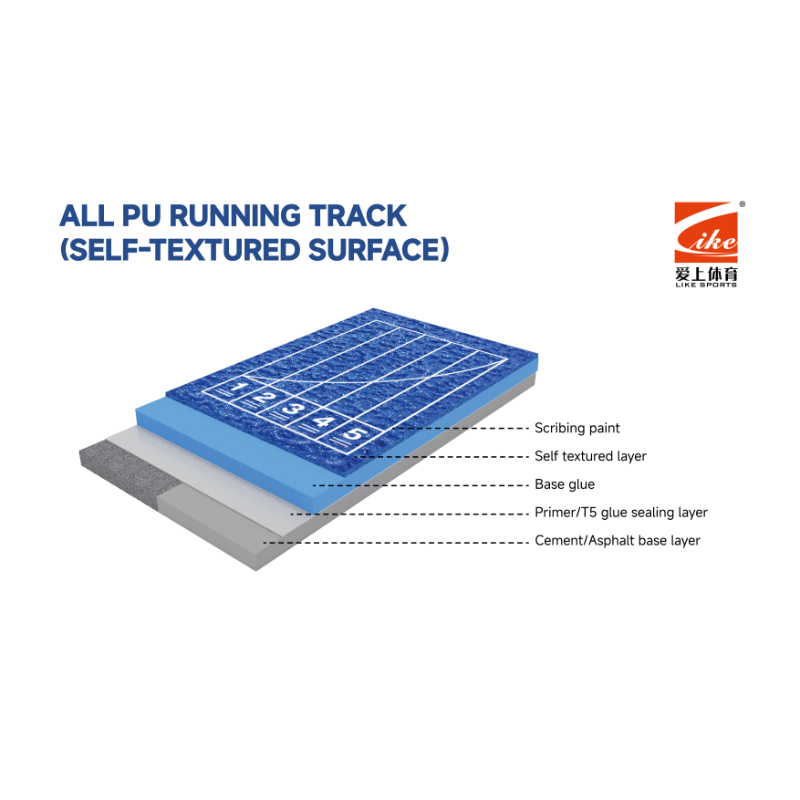
An all-PU self-textured track uses polyurethane throughout the main surface structure and creates its texture through the finishing layer rather than loose spray-applied granules.
The system is suitable for projects that prioritize:
Consistent surface performance
Stable color
Impact absorption
Slip resistance
Frequent daily use
Relatively straightforward maintenance
LIKE SPORTS recommends this construction for schools and universities that require a durable surface for regular training and competition. Its listed thickness range is 13–17 mm, with shock absorption of 35–50% and sliding resistance of 86 BPN.
This option may be appropriate when the facility expects heavy daily traffic and wants a uniform surface without a visibly granular top layer.
Before selection, confirm the substrate condition, required track classification, line-marking system and local climate. An all-PU track still requires a stable, level and properly drained base.
The spray granular version uses an all-PU base combined with a textured spray-applied surface. The upper layer improves grip and creates the familiar appearance found on many outdoor synthetic tracks.
The system has a reference thickness of 13–15 mm, shock absorption of 35–50% and sliding resistance of 78 BPN. The manufacturer positions it for community sports facilities and recreational areas where outdoor durability and grip are important.
This type may be considered for:
Community stadiums
School athletic fields
Outdoor jogging facilities
Public recreation centers
General training tracks
Buyers should ask how the spray layer is bonded to the base, which granule material is used and how color stability is controlled. Surface-layer quality directly affects appearance, grip and future maintenance.
A hybrid running track combines polyurethane with rubber granules to balance elasticity, impact absorption and project cost.
The self-textured hybrid system offered by LIKE SPORTS has a reference thickness of 12–15 mm, shock absorption of 35–50% and sliding resistance of 88 BPN. The company recommends hybrid systems for professional training centers and higher-performance facilities.
The rubber-containing elastic layer can help create a comfortable surface for repeated training. However, the exact response of the track depends on:
Rubber granule size and quality
PU binder content
Layer thickness
Installation consistency
Base hardness
Environmental temperature
For comparison between suppliers, request a complete layer diagram rather than comparing only total thickness.
The hybrid spray granular system combines an elastic PU-and-rubber base with a textured upper surface.
Its listed performance includes:
Thickness of 12–15 mm
Shock absorption of 35–50%
Sliding resistance of 88 BPN
Textured grip
Stable color and adhesion
LIKE SPORTS positions this system for intensive training and venues that require both elasticity and a textured competition-style surface.
This construction can be a practical option for projects seeking a balance between performance and material cost. The buyer should still confirm whether the proposed system meets the required competition, school or local safety standard.
A water-permeable running track is designed to allow rainwater to pass through the surface structure instead of remaining on top of the track.
LIKE SPORTS lists a thickness range of 10–13 mm, shock absorption of 35–50% and sliding resistance of 86 BPN for its permeable system. It recommends the product for areas with heavy rainfall and multipurpose facilities where faster surface drainage is important.
A permeable system may be suitable for:
Rainy or humid regions
School playgrounds
Community jogging tracks
Recreational sports areas
Multipurpose outdoor facilities
The surface alone cannot solve every drainage problem. The underlying asphalt or concrete base, slope, drainage channels and surrounding landscape must also be designed correctly.
For locations with frequent standing water, ask the contractor to evaluate both vertical permeability and overall site drainage before selecting the track system.
Schools usually need a surface that supports daily physical education, athletics training, recreational use and occasional competitions.
Important priorities include:
Safety for students of different ages
Reliable shock absorption
Slip resistance in wet conditions
Low odor during and after installation
Easy cleaning and repair
Resistance to frequent use
Compliance with local environmental requirements
An all-PU self-textured system may be appropriate for schools requiring a durable, consistent surface. A hybrid system may offer a practical balance for larger campuses, while a water-permeable track may be preferred in regions with frequent rainfall.
The final choice should reflect daily user numbers, whether the facility hosts competitions, the base condition and the available maintenance budget.
Professional stadiums and training centers normally require more detailed performance control than recreational facilities.
Buyers should confirm:
Track classification requirements
Surface evenness
Force reduction or shock absorption
Vertical deformation
Wet and dry slip resistance
Tensile strength
Weathering performance
Spikes resistance
Line-marking accuracy
Product certification
Installer qualifications
LIKE SPORTS reports that its products have been installed over more than 50 million square meters across 46 countries and that selected products hold World Athletics and Chinese Athletics Association certifications.
For a competition project, request the certificate for the exact track system being offered. A supplier’s general company certificate does not necessarily cover every product, thickness or installation method.
Before approving an eco-friendly running track, ask the supplier for documents relevant to the destination market and project.
These may include:
Environmental certification
Heavy-metal test report
Volatile organic compound test
Product safety data sheet
Raw material specifications
World Athletics product certificate where required
Physical-performance test report
Installation method statement
Quality-control plan
Warranty conditions
The documents should identify the tested product name, layer structure, thickness and applicable standard. Generic reports that do not match the offered system provide limited value during technical approval.
To receive a suitable running track proposal, provide:
Project location
Total track area
Number of lanes
Track dimensions
School, recreational or competition use
Required certification
Existing base type
New construction or renovation
Local temperature range
Annual rainfall
Preferred surface type
Required thickness
Color and line-marking requirements
Installation responsibility
Target completion date
Photographs, layout drawings and base-condition reports can help the supplier identify potential installation risks before quotation.
There is no single eco-friendly running track that is suitable for every facility.
Choose an all-PU self-textured track when you need a durable and consistent surface for schools or high-frequency daily use.
Choose an all-PU spray granular track when outdoor grip and a traditional textured appearance are important.
Choose a hybrid track when the project requires elasticity and impact absorption with a balanced system structure.
Choose a water-permeable track when rainfall and drainage are major project concerns.
The final purchasing decision should combine environmental documentation, technical performance, base conditions, installer capability and long-term maintenance—not only the initial price per square meter.
Please leave message
Please leave message 




+86 181 2230 3341


